

ERPNext is the world's best free and open source ERP

Proprietary ERPs are expensive, limiting, and rigid. Businesses are left with two choices, either spend through the roof on SAP, Oracle NetSuite, etc., or use multiple disconnected apps leading to manual work, poor visibility, and broken traceability. What if there is a better way?
ERPNext is a 100% open-source enterprise resource planning software with a modern, comprehensive, and user-friendly Enterprise Resource Planning (ERP) solution. We don't have any features hidden behind expensive paywalls. Everything is yours to use, modify, or resell giving you full freedom, control, and flexibility.
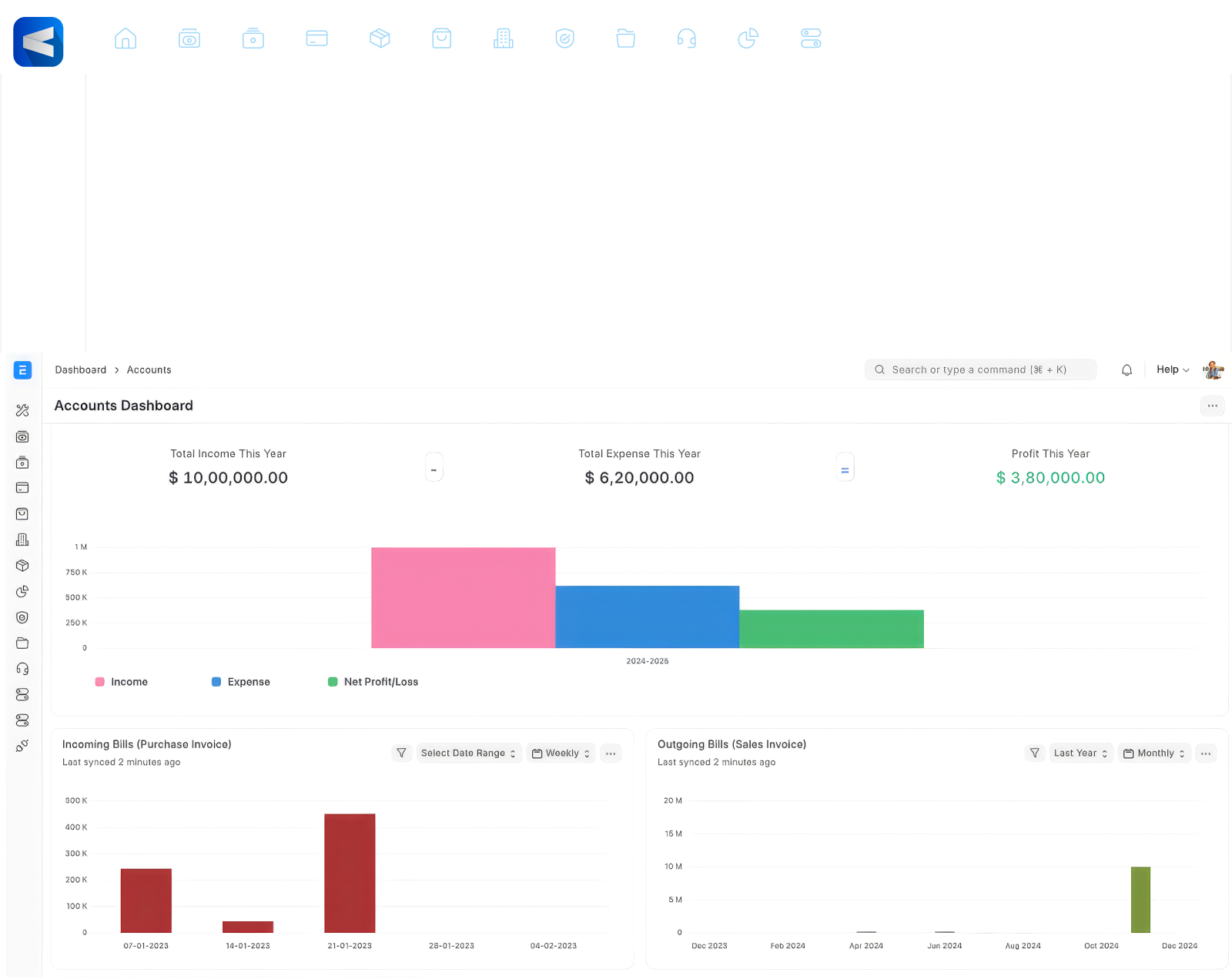
ERPNext is a comprehensive enterprise resource planning software with everything your business needs to operate and grow. This includes accounts, invoicing, sales, procurement, stock, manufacturing, projects, POS, HR, payroll, and more. It works out of the box for almost any industry and country and can be customised to fit unique needs with its very own low-code, no-code builder.

Automate tasks withdrag-and-drop simplicity.

Manage all modules from any device.

Forms, reports, print formats, and dashboards.

Simplify with custom multi-level workflows.

Granular access control to safeguard data.

Easily integrate with third-party systems.
Manage multiple subsidiaries, branches, and currencies in a single system with consolidated reports. ERPNext supports tax compliance out of the box or allows easy configuration for almost any country. If your country's compliances are not available out of the box, our global partner network can help you build one.
ERPNext stands out from other ERP software by being fully open-source, cost-effective, and designed with small and medium businesses in mind. Unlike many traditional ERP systems that are complex to use, ERPNext offers an intuitive user interface, which helps users learn fast and use with ease. There is no 'Per User Fee' for ERPNext. This helps growing businesses reduce the Total Cost of Ownership (TCO) as compared to legacy ERP software. ERPNext is open source – that means there is no vendor lock-in, unlike traditional ERP systems, where you are at the mercy of the OEM and their implementation partner for even small modifications.
Yes, ERPNext is built to scale alongside your business. It supports multi-company setups, user roles, advanced user permissions, and can manage high transaction volumes. As your business processes evolve, ERPNext can be extended with additional modules, custom workflows, and third-party integrations. Cherry on the cake – ERPNext has no 'Per User Fee'. You will need to pay only for the extra compute capacity needed. So cost doesn’t increase linearly with your scale.
Not necessarily. ERPNext is designed to be user-friendly and can be implemented without a dedicated IT team. Many small businesses set up ERPNext on their own using ERPNext's online documentation. For basic implementations, we have Success Packs (available in limited regions) where our certified partners help you get started quickly for a small fee. However, for more complex setups or customisations, you may choose to work with an ERPNext implementation partner in a dedicated engagement. You can find a suitable partner for your use case.
Implementation time varies depending on the size of your business and the number of modules you're using. For most small businesses, an ERPNext implementation can take anywhere from 2 to 8 weeks. Deployments with standard modules like Accounting, CRM, and Inventory are often completed faster. More advanced features like Manufacturing or custom workflows may require additional planning and data migration.
ERPNext offers extensive support options to ensure a smooth experience post-implementation. You can access free online documentation, community forums, video tutorials, technical support via HelpDesk directly from the ERPNext team. If you have implemented ERPNext via any of our certified partners, they will help you fix basic issues and escalate to the Frappe team in case of advance cases and bug fixes.
Yes, ERPNext is designed to integrate with other business tools through its RESTful API and a growing ecosystem of Marketplace apps. Common integrations include authentication tools (LDAP, fairlogin), backup methods (Dropbox, Google Drive, Amazon S3), bank integrations (Plaid), payment gateways (Stripe, PayPal, RazorPay, GoCardless, Braintree, M-pesa, Paytm), ecommerce platforms (Shopify, WooCommerce, Amazon, Unicommerce, Zenoti), and communication tools (Twilio, Exotel). This ensures that your ERP system works seamlessly with the software you already use, reducing double entry and improving efficiency.
ERPNext is highly flexible and works well for service-based businesses in addition to traditional industries like manufacturing, distribution and retail. It includes modules for project management, timesheets, invoicing, CRM, help desk, and HR – all of which are essential for service providers. Whether you run a consultancy, IT services firm, digital agency, or legal practice, ERPNext provides the tools to manage operations efficiently within a single ERP system.



All-in-One Business Management System.